


Korea's China Gate Got Easier in 2026. France's Did Not.
China's customs administration moved Chinese-label review online in April 2026 and granted low-risk cosmetics shipments release on inspection. In July the drug regulator dropped ingredient registration codes and widened animal-testing exemptions. In October an industry association said roughly 15% of some French companies' cosmetics were sitting at Chinese customs and registration desks. Nothing in the published rulebook separates those two outcomes.
What did China actually change for cosmetics importers in 2026?
Two agencies control whether an imported cosmetic reaches a Chinese shelf. The General Administration of Customs, or GACC, clears the physical shipment. The National Medical Products Administration, or NMPA, controls the registration file — the dossier an importer must lodge before a product may be sold at all. Both moved in the same direction through 2026, and both moved toward the importer.
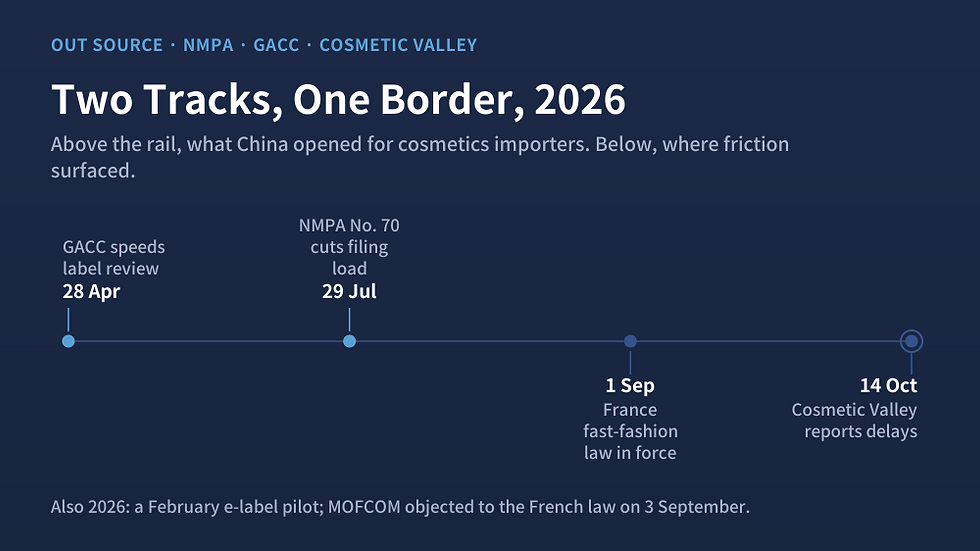
GACC published a set of cross-border trade facilitation measures on April 28, 2026. For imported cosmetics the operative change was procedural rather than tariff-related: review of the Chinese-language label shifted from paper to online, and low-risk consignments became eligible for system-automated review, which the administration described as inspection and release on arrival. That built on an NMPA pilot opened on February 1, 2026 allowing electronic Chinese labels for a three-year period in Beijing, Shanghai, Zhejiang, Shandong, Guangdong and Chongqing, with Hainan duty-free cosmetics also eligible. The pilot keeps the substantive requirements in place — product name in Chinese, license number for special cosmetics, registrant name, net content, shelf life and safety warnings still have to reach the consumer — and moves the delivery mechanism to a QR code of at least nine millimeters square.
The larger change came on July 29, 2026, when the NMPA issued Announcement No. 70 of 2026 on cosmetics licensing and registration, effective on the day it was published and overriding earlier NMPA documents where they conflict. It sets out seven simplifications. Ingredient registration codes and raw-material safety documents no longer have to be entered at filing; the applicant lists the ingredient manufacturer and keeps the safety data on file for inspection, and the NMPA will stop publishing the codes. Animal-testing exemptions widened to cover perm products, non-oxidative hair dyes, whitening products that work only by physical covering, and general cosmetics using new ingredients — children's cosmetics excluded, and conditional on the manufacturer holding a home-country GMP certificate and on a safety assessment carrying the argument. Similar-formula products under one brand and one holder may share microbiological, physicochemical, toxicity and human safety testing from a single representative product. Test data survives a move of production between China and overseas if registrant, name, formula and standards are substantively unchanged. Outside freckle and whitening, UV protection and hair-loss claims, companies may choose their own efficacy test methods. And a product launching in China first, or simultaneously, can file a China-first launch commitment instead of proving it already sells in its home market.
That last provision is worth isolating. It removes the structural disadvantage faced by a brand that wants China as a launch market rather than an export afterthought.
What is the French industry association actually claiming?
Marc-Antoine Jamet, president of the French industry association Cosmetic Valley, told reporters on October 14, 2026 that some French cosmetics exports were facing delays clearing customs in China. The figure attached to the claim is roughly 15% of products from some member companies, held up at customs and registration procedures. China is France's second-largest cosmetics export market, worth about €1.8 billion a year against total French cosmetics exports of €22.4 billion.
The attribution matters more than the number. The 15% is an estimate drawn from member companies, not a measurement published by any customs authority. Chinese authorities did not comment on the delays. No filing, notice or official statistic underwrites the claim, and the association has not published the method behind it. What exists is a trade body's characterization of what its members report.
That is not a reason to dismiss it. Industry associations are usually the first to see a clearance problem, because they aggregate complaints that individual firms have commercial reasons not to make. It is a reason to hold the claim at the level it was made.

Why does a cosmetics complaint point at a fashion law?
France's anti-ultra-fast-fashion law took effect on September 1, 2026, imposing environment-related penalties on applicable textile products. China's Ministry of Commerce responded publicly within days, urging France to halt implementation and describing the law as discriminatory; France's foreign ministry rejected the discrimination characterization. European measures on low-value parcels sit alongside it in the same dispute.
The association's reading is that the cosmetics delays follow from that quarrel. The sequence supports the reading without establishing it. A law takes effect on September 1, a government objects on September 3, and an exporters' body reports clearance friction on October 14. No Chinese authority has stated that cosmetics clearance reflects anything other than ordinary procedure, and no public document links the two. Suggestive ordering is not proof of mechanism.
It is also worth noting what is not being alleged. Nobody has claimed a tariff, a quota, a ban, or a rule change aimed at French cosmetics. The complaint is about pace.

How exposed is France, and how exposed is Korea?
France sends about €1.8 billion of cosmetics to China out of €22.4 billion in total cosmetics exports, which puts China at roughly 8.0% of the national total. Korea's Ministry of Food and Drug Safety released first-half 2026 figures on July 3, 2026: about US$1.01 billion to China out of about US$7.0 billion overall, or 14.4%.
Korea leans on the Chinese cosmetics market close to twice as hard as France does, measured as a share of national output. This is the inversion in the story. The exporter being slowed is the less concentrated of the two.

Korea's share has fallen hard and fast from a much higher base, which is why 14.4% reads as diversification rather than dependence. The first half of 2026 was the period in which the United States consolidated its position as the largest market for Korean cosmetics, at about US$1.45 billion and 20.7% of the total, up 41.5% year over year. Japan took about US$0.58 billion, 8.3%, up 5.9%. Total exports rose 27.3% to a record first-half figure. A falling share of a growing total is a different thing from a retreat, and China's absolute decline was US$70 million on a base above a billion.
Did Korea's China decline come from a gate or from demand?
The category breakdown answers this more clearly than the headline number. Korean basic skincare to China fell 7.2%, from about US$830 million to US$770 million. Body cleansing products fell 25.0%, from about US$72 million to US$54 million. Color cosmetics were essentially flat, down 0.3%, from about US$117.9 million to US$117.5 million.

A clearance or registration bottleneck does not produce that shape. Customs handles a consignment, not a category; a registration queue lengthens by dossier type, and color cosmetics in China carry at least as much filing burden as a cleanser. A gate that cut cleansers by a quarter while leaving color untouched would be a strange gate. Uneven category movement of this kind is what demand, channel mix and local competition look like.
The contrast outside China sharpens it. Korean basic skincare to the United States rose 48.6% in the same half, from about US$740 million to US$1.10 billion, and personal cleansing to the US rose 36.4%. The same products, the same producers, the same half-year, moving in opposite directions in two markets. One analyst reading attributes part of the US surge to stock-building ahead of tariff increases; that is an interpretation offered by market analysts, not a figure anyone has established.
So the available evidence does not show Korean cosmetics facing the clearance problem the French association describes. No Korean industry body has reported one, and the export data does not carry its fingerprint. The honest position is that Korea's China decline and France's China delays are two different phenomena that happen to involve the same border.
What does the registration file actually control?
An imported cosmetic cannot be sold in China until its dossier is accepted. General cosmetics are filed; special cosmetics — including sunscreens, whitening products and hair dyes — require a license, which is a substantive approval rather than a notification. The dossier is where the formula, the safety assessment, the efficacy evidence and the labeling all converge, and it is reviewed by people applying standards that leave room for judgment.
This is the part of market access that behaves least like a rule and most like a queue. A tariff line — the code in a customs schedule that fixes the duty on a given class of goods — is a published number that an importer can read, forecast and contest. The time a dossier spends in review is none of those things. It is not published, it is not uniform, and a delay inside it is indistinguishable from ordinary diligence.
That asymmetry is the reason a registration queue is a usable instrument and a difficult accusation. There is nothing for the affected exporter to point at.

Which lever is written down, and which is not?
Everything China did for cosmetics importers in 2026 arrived as a published document with a number and a date. GACC's facilitation package is dated April 28. The NMPA's registration overhaul is Announcement No. 70 of 2026, effective July 29. The electronic-label pilot has a start date, a province list and a duration. Each is citable, and each can be reversed only by another document of the same kind.
What the French association describes has no document. There is no notice instituting it, no effective date, no scope and no stated end. It cannot be cited, which also means it cannot be formally challenged, appealed or made the subject of a trade complaint in the way a published measure can.
Both tracks currently point Korea's way. The registration burden on Korean exporters fell in July, the label process got faster in April, and no Korean clearance problem has been reported. That is an accurate description of the present and not a structural protection. The measures that helped were discretionary when they were granted, and discretion does not change character because it has been exercised favorably.
What does this leave for the rest of the industry?
For manufacturers, the registration file has become partly a product of the plant rather than the laboratory. An animal-testing exemption that is conditional on a home-country GMP certificate turns that certificate into an export asset with a measurable value, and makes the choice of production site a regulatory decision rather than a cost decision. Data-sharing across similar formulas rewards portfolio structure over one-off reformulation.
For brands and buyers, a market whose entry cost falls by notice can see it rise the same way. Fourteen percent of national output in a single market is a concentration whether or not anything is currently going wrong in it, and the relevant comparison is not Korea against its own past but Korea against the exporter now reporting friction. France is at eight.
For regulators and investors, the French case describes a trade measure that is hard to price. It leaves no mark in a tariff schedule, the acting government has not confirmed it, and the affected industry can only estimate its size. Published rules can be argued with. Queues cannot.


Comments