


Own the Factory, Lose the Customer: The Brutal Economics of $5.97 Shampoo Monday
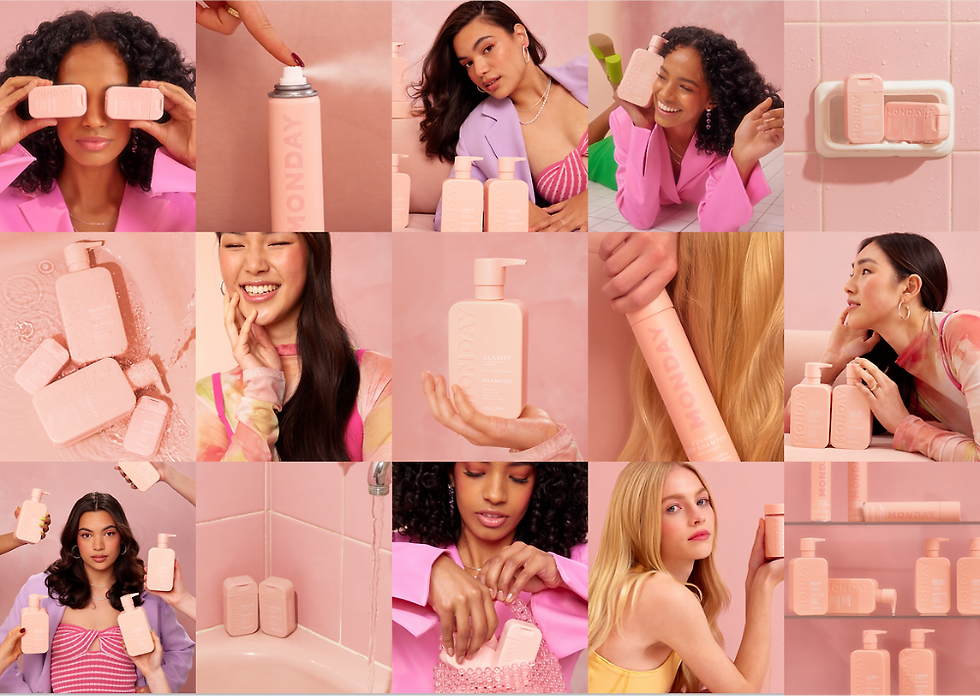
Walmart’s US site lists MONDAY Haircare shampoo at $5.97 for 354 millilitres. The brand takes no direct orders anywhere: its own website has no checkout, only a stockist finder. It does own the plant that fills the bottle. Most beauty companies treat the factory as the thing to rent and the customer relationship as the thing to keep. This company inverted both, and the price on the shelf is what the inversion pays for.

What does $5.97 actually buy on a mass shelf?
Walmart’s brand page lists a 354-millilitre Volume Shampoo at $5.97, a Smooth Shampoo and Conditioner pair at the same price, a 798-millilitre Moisture Shampoo at $12.97 and a 200-millilitre dry shampoo at $8.99. Texturising mousse, heat protectant, hairspray and a deep moisture mask all sit at $6.97. Nothing on the page clears $18.
The same shape holds in other currencies. The Boots listing in the UK shows a 350-millilitre shampoo at £3.33, marked down from £5.00. In Australia the brand opened at Coles at $10 a bottle. The range has widened since launch into body wash, styling and treatments, and the ceiling has not moved with it.
A band this tight across four categories and three currencies is not a promotional posture. It is a constraint the business accepted before it designed anything.

Why has the entry price moved down rather than up?
Reporting in 2022 put the range at $7.99 to $15.99, with a 12-ounce bottle at $8. The current entry price at Walmart is below that in nominal terms, four years and one inflationary cycle later, while the assortment has grown.
The company’s own explanation has been consistent: vertical integration and quality control are what allow it to hit mass price points and still protect margin. That is a statement about structure, not about procurement. A buyer who negotiates well gets a better cost on a given order. A business that owns the line changes what the cost is made of.
The difference shows up when inputs move. A brand buying from a contract manufacturer renegotiates, absorbs, or reprices. A brand that owns the plant has fewer counterparties to renegotiate with and a longer horizon over which to absorb. The flat shelf price is the visible end of that.
What changed when the brand stopped renting its factory?
It started the way most do, with third-party manufacturing. The parent’s stated pattern is to outsource a brand at launch and bring production in-house once the brand proves itself. For this one that meant a 27,000-square-metre innovation and development facility in China with capacity above 100 million bottles a year, roughly eight a minute, with a former L’Oréal head formulator leading research. Those capacity figures are the company’s own.
Two things disappear when a brand crosses that line. One is the manufacturer’s margin. The other, less discussed, is the manufacturer’s calendar. Short lots, reformulations, a pack change for one retailer, a texture variant for one market — these stop being commercial negotiations and become internal scheduling. Speed to shelf is mostly a scheduling problem.
What arrives in their place is fixed cost. A hundred million bottles of annual capacity is a utilisation problem before it is an advantage, and it has to be filled from somewhere. The rest of this company’s behaviour follows from that sentence.

In what order does this company take a country?
The brand was developed in 2019, took its first retail listing in New Zealand grocery at the end of that year, and launched in February 2020. The company says it held more than a quarter of the haircare category at that grocery group within 20 days. Its claim to have outsold the market-leading shampoo brand after moving to Coles in Australia has been retold with different timeframes — six weeks, seven weeks, three months — and all of those figures are the company’s own.
The Australian sequence is the part worth reading closely. Coles first, a grocery chain. Big W next, earlier in 2026, a general merchandiser. Then 280 Kmart stores in early October 2026, a discount variety chain, with a six-item range: moisture shampoo and conditioner, dry shampoo, leave-in conditioner, deep moisture mask, repair oil and heat protectant spray. That took the Australian footprint past 1,200 stores.
Every step in that order is a wider door at a lower average basket. Brands usually run this in reverse, starting narrow and premium and defending the price as they widen. Starting at grocery means the opening price is set by the hardest buyer in the market, and every subsequent door has to accept it rather than set it.

Why does a beauty brand refuse to sell direct?
There is no direct-to-consumer business, and that is deliberate rather than unfinished. The brand’s site carries product pages, an ingredient explainer, an FAQ and a regional selector for seven markets, and its only purchase route is a stockist locator. The founder’s stated reasoning is that the company partners with mass retailers because they run retail better than it could.
The arithmetic supports her. Direct selling adds fulfilment, returns, payments and customer service, and above all customer acquisition cost. On a $5.97 unit, acquisition cost is the line that ends the business. Refusing the channel also removes the oldest argument in the buyer’s office, which is the brand’s own site undercutting the shelf.
The saving is real and so is the price of it. Every shopper who buys the product is the retailer’s shopper. That is the part the model cannot fix, and it comes back at the end.
What does the company do once it has the shelf?
It runs the same entry again with a different name. In July 2024 it launched being, a second haircare brand, exclusively at Walmart at under $7, having come in through Walmart Start, the retailer’s own programme for emerging beauty brands. The line is organised by hair type rather than by concern, spanning the 2A to 4C range, and the company has described it as the retailer’s number one new shampoo and conditioner brand.
In February 2026 that brand widened into Target stores nationwide with five additions at $7.99 — two mousses, a detangling milk, a smoothie and a moisture mousse — alongside listings at Ulta Beauty, Amazon and CVS. Nineteen months separate the exclusive launch at one chain and the national rollout at its closest competitor.
Read as a pattern rather than two announcements, this is a company using a retailer’s own emerging-brand pipeline as a product development channel, then taking the proven result across the street. The second brand did not need to find a shelf. It was built against one.

How many brands is this business actually running?
More than the haircare label suggests. The parent’s consumer division has launched nappies, supplements, collagen, deodorant, bodycare and fragrance under separate names, beginning with a nappy brand in 2017 that became one of the largest in its category worldwide. The founder has added a naturals line, a fragrance house, a Gen Alpha bodycare brand that opened at Ulta Beauty and moved into Target, and a hairstylist-led brand that launched into Target nationwide. The stated plan has been ten brands by 2026.
The headcount makes the point sharper. The consumer division runs on roughly 250 people, of whom about fifteen work on the flagship haircare brand. The group employs more than five thousand across nearly thirty offices, one of which is in Bentonville, Arkansas, where Walmart is headquartered. The business was self-funded apart from a small family loan at the start.
Fifteen people on a brand that holds tens of thousands of doors is only possible if the brand is not the asset. The asset is the line behind it and the buyer relationships in front of it, and both of those are reusable. That is how a factory with a hundred million bottles of capacity gets filled.

Where does the model run out?
At the shelf edge, in two directions. The first is informational. With no direct channel, the company has no transaction of its own to count, no price test it can run alone and no record of who buys. Its own site currently lists 31 countries while company figures have put the market count higher, and there is no internal order book that settles the difference. A business that cannot count its customers is reading its market through its buyers.
The second limit is structural, and it is the sharper one. Owning the plant is a durable advantage against brands that rent one. It is not an advantage against a retailer’s own line, which also controls its supply, carries no brand marketing to fund, and sits on the same fixture with the shelf position decided in-house. Every chain that takes this brand for its opening price point already knows how to build the alternative, and now has a demonstrated price to build it against.
The factory bought the price. The price bought the shelf. The shelf still belongs to someone else.


Comments