


Olaplex and the Miracle of Alchemical Bonding: the Trillion-Dollar Legacy Born in a Garage
Along the quiet, serene coastline of Santa Barbara, a revolution was brewing that would upend the beauty industry. Started in 2014 out of Dean Christal’s garage, this movement was destined to make noise: it directly challenged "hair damage"—a barrier the beauty world had accepted as inevitable for decades.
Garages are cradles for industry disruptors. Just as Steve Jobs launched Apple in his parents' garage to usher in the PC era, Dean prepared to flip the professional haircare industry on its head from his own oil-stained floor. The age-old business axiom held true once again: single-minded obsession nurtured in isolation can reshape entire markets.

The Problem
Dean Christal was an industry veteran who understood the inner workings of the beauty market better than most. Coming from a family steeped in the hair business, he pinpointed the exact pain point troubling stylists worldwide: the dreaded damage and breakage caused by chemical treatments like perms and bleaches. The industry consensus at the time was simple: to get vibrant or platinum blonde hair, you had to sacrifice its health. "Beauty is pain" was reframed in salons as "beauty requires destruction."
Existing giants offered band-aid solutions—silicone and heavy oils that temporarily masked damage on the surface. Dean wanted a real fix that prevented structural destruction entirely. While beauty conglomerates poured billions into marketing illusions, Dean spent years combining ingredients in his garage late into the night, hunting for the key to fix structural hair flaws.
Science Crashes the Salon
Dean didn’t initially set out to create a brand-new "hair resuscitation" category. He simply wanted a silicone-based oil to rival Moroccan Oil. Everything changed when he met Dr. Craig Hawker, a world-renowned chemist at UC Santa Barbara. Dr. Hawker and his colleague Dr. Eric Pressly were authorities in polymer science and materials engineering—with zero prior ties to the beauty industry.
When Dean explained how hair breaks down, the two scientists viewed it through pure molecular chemistry. Just as Roman concrete stood the test of time through an unexpected blend with volcanic ash, the beauty industry’s breakthrough came from scientists speaking an entirely different language.
To them, hair was a matrix woven together by disulfide bonds—tiny molecular bridges. Strong alkaline chemicals sever these bridges, causing the structure to collapse. Within a day of hearing Dean’s problem, the chemists posed a straightforward hypothesis: construct a new molecular link to rejoin those broken bonds.

When Dean begged them to stop hair from melting off, they responded with casual scientific logic:
"Why not just place a new molecular bridge between the broken bonds? It’s basic structural reinforcement."
Chemical Proof, Not Magic
Their hypothesis birthed Olaplex’s core ingredient: Bis-Aminopropyl Diglycol Dimaleate.
Instead of coating the hair strand like traditional treatments, this active compound penetrates deep into the cortex. It seats itself between broken sulfur ($S$) bonds, acting as a sacrificial bridge that locks both sides back together. It was a cast for broken bones—a needle repair for a torn net. The moment Dean held the formula, he knew it was a game-changer.
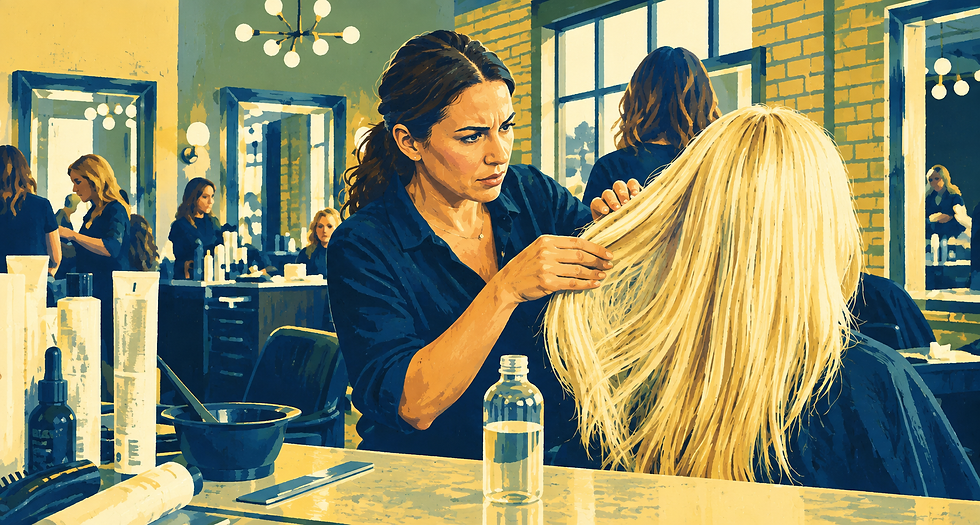
Olaplex birthed the category of fundamental hair repair, signaling the end of superficial mask treatments. Miracles unfolded directly in salons when colorists mixed this clear liquid straight into harsh bleaches. Instead of snapping, hair came out stronger.
Olaplex created a multi-billion-dollar market behind a single active ingredient and one core patent. Consumers stopped falling for glossy branding; the physical reality of restored hair elasticity elevated Olaplex from a product to a near-religious staple.
The Hollywood Breakthrough
While the theory was sound, the market was skeptical. Tired of false claims, consumers were wary of "miracle" hair products. Skip the PR agencies, Dean went straight to the source: Hollywood celebrity colorist Tracey Cunningham, whose clients included Gwyneth Paltrow, Jennifer Lopez, and Kim Kardashian.
Tracey tested the sample on a client the very next day. The result was remarkable. Hair that typically turned straw-brittle after repeated bleach sessions retained its elasticity and shine. Overjoyed, Tracey called Dean:
"Dean, what is this stuff? It’s absolute magic! I’m never coloring without it again."
Word from an industry titan proved far more powerful than any ad campaign.

The Instagram Engine
Olaplex bypassed traditional media advertising completely, leveraging the visual boom of Instagram in 2014. Stylists globally began posting unedited "Before & After" photos showcasing drastic hair transformations.
Clients began walking into salons showing phone screens, demanding the exact treatment they saw online. Olaplex flipped the dynamic—demand was driving supply. Within four months of launching, Olaplex was in 7,000 salons; six months after signing global distribution deals, that number surpassed 100,000, pulling in tens of millions in revenue.

War with a Titan: L'Oréal
Fast growth invited corporate friction. In 2015, L'Oréal approached Olaplex with an acquisition offer. During due diligence, Olaplex shared confidential trade secrets, patented mechanisms, and proprietary formulas. Negotiations ultimately broke down.
Shortly after, L'Oréal launched products containing hair-bonding technology strikingly similar to Olaplex's core mechanism. Olaplex sued, alleging patent infringement and trade secret theft.
Period | Litigation Outcome |
2019 (District Court) | Jury sides with Olaplex; orders L'Oréal to pay $91M in damages. |
2021 (Appeals Court) | Federal Circuit reverses verdict, ruling in L'Oréal's favor. |
Settlement Phase | Long-term lawsuit ends in a confidential settlement. |
While Olaplex proved a startup could stand up to a conglomerate, losing exclusive enforcement in court dissolved a key legal moat, allowing competitor copycats to enter the market.
Stumbling Blocks: The Test of Safety and Market Shifts
By 2023, Olaplex faced significant backlash on the very platform that built it: social media.
Class-Action Lawsuit: Posts alleging hair breakage and scalp irritation spread online, leading 28 consumers to file a class-action lawsuit.
EU Ingredient Regulation: Lilial (butylphenyl methylpropional), used as a fragrance ingredient, was banned in the EU due to reproductive toxicity concerns.
Olaplex immediately released updated formulations without Lilial and published extensive third-party clinical testing data showing product safety. The court eventually dismissed the class-action suit due to a lack of direct causal evidence linking the products to individual hair damage.
Despite legal vindication, public sentiment cooled. Olaplex’s stock fell roughly 90% from its peak. Compounding the trouble, co-inventor Dr. Eric Pressly departed to launch a competing brand, Epres, introducing next-generation bonding technology.
The Henkel Acquisition: A Strategic Pivot
To recover, Olaplex brought in new management, dialed back influencer marketing, and refocused on building relationships directly with professional hairstylists through clinical proof.
This refocusing caught global attention. In March 2026, German consumer goods giant Henkel announced its acquisition of Olaplex for $1.4 billion. Though critics pointed out the valuation drop from its 2021 IPO peak, Henkel targeted the underlying core asset: Olaplex's pioneer bond-building technology and brand equity. Combined with Henkel’s global distribution network and capital, the acquisition serves as a strategic retreat designed to stabilize and rebuild long-term market dominance.
Reconnecting the Pieces
Olaplex's 12-year journey mirrors the reality of modern business. It fused two completely separate domains—molecular science and haircare—bridged the gap between professional salons and everyday consumers, and navigated immense corporate and legal battles.
More than just a trend, Olaplex shifted the industry paradigm from temporary surface coating to fundamental structural repair. Backed by global infrastructure, its foundational science continues to shape the future of hair technology.


Comments