


An Insurance Giant, a Family Office, and an Icon: The Risky Math Behind the Boots Deal
Wittington Investments agreed on 7 October 2026 to acquire Boots for US$8.9 billion including assumed debt. Fairfax Financial committed up to approximately US$2.3 billion and expects to own 50% of the equity at close. The transaction is being read as a British institution passing into the hands of a long-term family owner. The disclosed terms describe something narrower: one buyer holds the operating control, a second holds half the economics, and the seller keeps part of the group.
What exactly changed hands on 7 October?
The Wittington announcement states that the total purchase consideration is US$8.9 billion, including assumed debt. Assumed debt means borrowings already sitting on the target’s balance sheet that transfer with it, so the figure is not the cash the buyers hand over. What they acquire is listed precisely: Boots’ retail operations in the UK and Ireland, the Boots Opticians business, No7 Beauty Company, and Boots’ Thailand and franchised businesses.
The same document names what does not transfer. The Boots Group’s interests in Farmacias Benavides, the Mexican pharmacy chain, and in Alliance Healthcare Deutschland, the German wholesaler, remain with Sycamore Partners and Stefano Pessina and his family. The announcement puts the workforce at more than 50,000 colleagues. Boots’ own corporate site, in a note dated 28 February 2026, describes an estate of over 1,800 stores.
Completion is expected in the first quarter of 2027, subject to regulatory approvals and customary closing conditions. Nothing moves before then.
Who owns Boots after this closes?
Most accounts of the deal name the Weston family as the buyer. Fairfax’s own release is more specific. It states that Fairfax has committed up to approximately US$2.3 billion under an equity commitment letter, and that it expects to own 50% of Boots’ equity after closing. Wittington holds operational control, and Galen Weston serves as Chair.
That is an unusual division. Half the economic upside sits with a property and casualty insurance holding company. All of the operating authority sits with the family holding company. The two things that normally travel together in a control transaction have been separated by agreement.
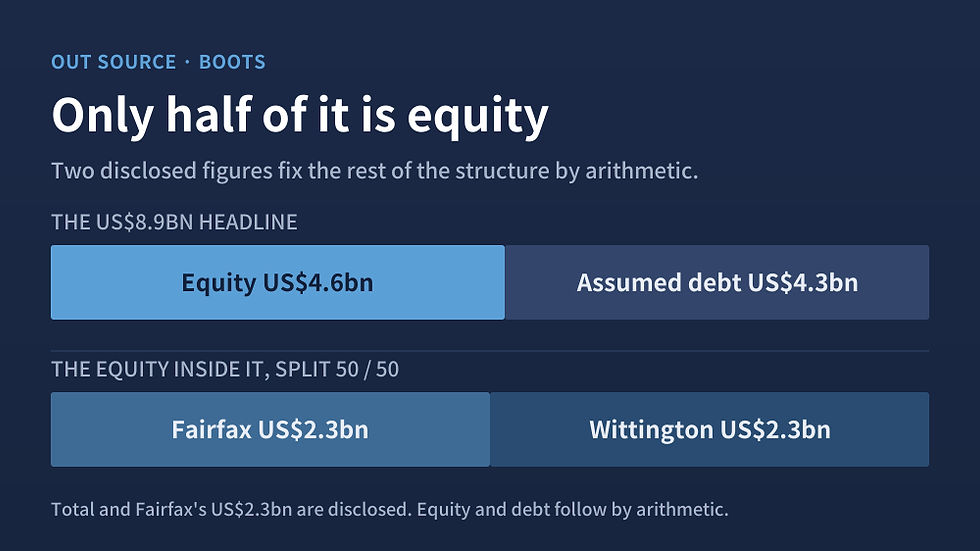
The two disclosed figures also imply a capital structure. If US$2.3 billion buys half the equity, total equity runs to roughly US$4.6 billion, which leaves approximately US$4.3 billion of the US$8.9 billion headline as assumed debt. That is arithmetic drawn from two published numbers, not a disclosed capital structure; neither release sets out the debt quantum.
Several trade accounts of the transaction reported that the economic split between the two buyers had not been disclosed. The split is in Fairfax’s release.

Why does No7 Beauty Company sit at the centre of this?
A retailer and a brand owner are different assets, and this transaction moves both. No7 Beauty Company was created inside Walgreens Boots Alliance in April 2021 to hold the group’s owned beauty brands: No7, Liz Earle Beauty Co., Botanics, Soap & Glory, Sleek MakeUP and YourGoodSkin.
Its own launch material described a business selling through more than 20,000 retail outlets across 16 markets, with No7 serums in over 16,000 stores in the United States alone. Those are the company’s figures for 2021 and no more recent equivalent has been published. The structural point survives the age of the number: No7 Beauty Company distributes well beyond the Boots estate, including through retailers that compete with Boots.
So the buyer acquires a shelf and a set of brands that fight for shelf space elsewhere. Those two positions pull in opposite directions on pricing, on exclusivity and on how much space an owned brand takes from a third-party one. Whoever runs Boots after close inherits that tension rather than resolving it.

What did the seller keep, and why does it matter?
This is a partial exit. Sycamore and the Pessina family retain the Mexican pharmacy chain and the German pharmaceutical wholesaler. What they sold is the consumer-facing retail estate and the owned beauty brands. What they kept is wholesale distribution and a pharmacy business in a different market.
Read against the original Walgreens Boots Alliance break-up, the pattern is consistent. The pieces with a British high street attached went to a buyer that wants a British high street. The pieces that are logistics and supply went nowhere.
Is the business being sold actually growing?
Boots’ accounts for the twelve months to the end of August 2025 show revenue of £7.545 billion (US$9.97 billion), up 3.2%, with revenue on a comparable basis up 5.8%. Pre-tax profit reached £337 million (US$445 million), up 25%. Post-tax profit was £261 million (US$345 million), against £211 million the year before. Digital sales rose 18.3%. Sterling figures in this article are converted at GBP/USD 1.3214, the Bank of England rate for 13 October 2026.
Boots attributes part of the improvement to a modernised beauty division. That attribution is the company’s own. A count of 61 brand additions during 2025, including Fenty Beauty and MAC, was reported at the time of the sale announcement; no company document setting out that figure has been published.
What Boots has published is the shape of the estate. It counted 170 premium beauty halls when it opened the Westfield White City hall in March 2023, and its site currently lists more than 500 beauty brands. The asset changing hands is a growing retailer with an expanding beauty assortment, not a distressed one.

What happened to the stock market listing?
Until this summer the expectation was a London listing. Reporting then put a sale back in play at a valuation around US$10 billion, with the Weston family’s Canadian arm and Australia’s Sigma Healthcare named among the parties in talks. The agreed consideration came in below that figure.
The difference between the two outcomes is disclosure. A listed Boots would have published quarterly results, carried a visible share price and faced analysts asking why a given category received a given amount of space. A privately held Boots does none of that. Category decisions that would have been argued in public will now be argued inside a holding company.
What does a Q1 2027 close mean for anyone negotiating shelf space now?
Regulatory approvals remain outstanding and the parties have set completion in the first quarter of 2027. Until then the buying organisation is the one that exists today, under chief executive Alex Baldock, operating to a plan written under the current owner.
A range review opened currently is therefore negotiated with one owner and executed under another. Terms agreed across that boundary carry a counterparty that changes mid-cycle. That is a documentation question, not a relationship question, and it applies to every supplier in the building.

Does Shoppers Drug Mart change what Boots is?
Wittington is the controlling shareholder of George Weston Limited, which controls Loblaw Companies Limited, which owns Shoppers Drug Mart. Loblaw acquired Shoppers in 2014 for approximately C$12.4 billion. The Wittington announcement describes Shoppers as Canada’s largest pharmacy, health and beauty business.
No combination of Boots and Shoppers has been announced, and no change to No7’s Canadian distribution has been announced. What the transaction creates is a single family holding company sitting above two of the larger health-and-beauty retail estates in two developed markets, each with its own owned-brand portfolio.
The group has owned and exited British retail before. Wittington acquired Selfridges in 2003 and sold the department store business roughly two decades later. Long-term ownership and permanent ownership are not the same commitment.

What does the structure settle, and what does it leave open?
For manufacturers and contract developers, No7 Beauty Company passes to an owner whose other retail assets buy owned-brand product at scale in a second market. The sourcing question that follows is whether two owned-brand portfolios under one holding company stay separate.
For brands and buyers, the counterparty at Boots is unchanged until the first quarter of 2027 and the owner above it is not. The negotiating position that matters is the one that survives a change of control.
For capital, Sycamore has priced a European health-and-beauty retail estate at US$8.9 billion including debt after preparing a listing and setting it aside, and has kept the wholesale assets. A buyer willing to split control from economics with an insurer is a buyer optimising for duration rather than exit.
Boots’ shelf did not change on 7 October. The clock running above it did.


Comments