


Galderma's $1.5bn ZO Deal Buys 16,500 Doctors, Not a Formula
Galderma's October 14, 2026 agreement values ZO Skin Health at US$1.5 billion in cash against about US$330 million in net sales. Five weeks earlier, a sale process at around US$2 billion was reported. What changes hands is not a molecule: more than 40 products, all made in the United States, moving through more than 16,500 physician, medical spa and online accounts in more than 40 countries. The formula is not the asset. The account list is.
What did Galderma actually sign on October 14?
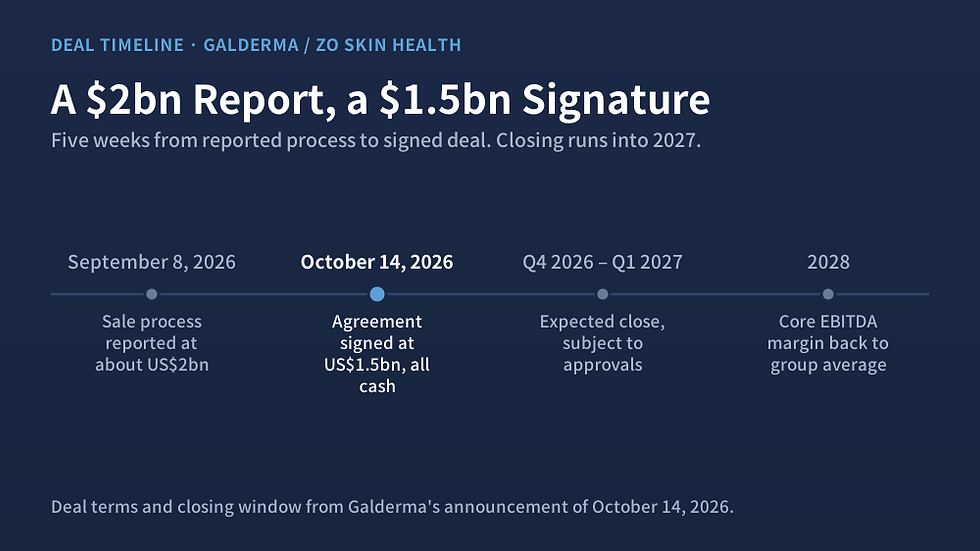
The agreement covers 100% of ZO Skin Health at an enterprise value of US$1.5 billion, all cash, subject to customary adjustments. Enterprise value is the price of the equity plus net debt, so it is what the buyer pays for the business rather than what the sellers receive for their shares. Galderma is funding it from existing cash reserves and bank financing. The sellers are shareholders including funds managed by Blackstone Tactical Opportunities and the Obagi family. Closing is expected in the fourth quarter of 2026 or early 2027, subject to regulatory approvals.
The target is a physician-dispensed brand, meaning its products reach consumers through a licensed medical practice, a medical spa or an authorized provider's online store rather than through open retail. The release puts ZO at approximately US$330 million in net sales in the last twelve months as of June 2026, with more than 40 products manufactured in the US and more than 16,500 accounts across more than 40 countries.
Galderma's own guidance on the arithmetic is specific. The deal is core EPS neutral in the first full year following closing, slightly dilutive to core EBITDA margin in 2027, and broadly comparable with the group average from 2028 onwards. The company also states it will increase commercial investment in the first year of ownership, with renewed growth expected from the second year.

Why did a US$2 billion process close at US$1.5 billion?
On September 8, 2026, a sale process for ZO Skin Health at a valuation of around US$2 billion was reported, with Citigroup and Raymond James advising and the process at an early stage. The signed number is a quarter below that. No party has disclosed what moved between the two figures, and an early-stage valuation floated by people close to a process is not a price.
The one public anchor is the acquirer's own language. Flemming Ørnskov, Galderma's chief executive, is quoted in the release saying the company sees "significant opportunities to reignite its growth through investment in innovation and commercial reach." Reignite is a verb used about a business that has cooled. Read alongside the commitment to a year of increased commercial investment before renewed growth arrives in the second year, the release describes an asset that needs work, not one running at full speed.
What does 4.5x sales mean next to the rest of 2026's beauty deals?
US$1.5 billion against US$330 million in net sales is about 4.5 times sales. DC Advisory's count of 2026 beauty transactions puts median valuations at about 3 to 4 times revenue and 12.5 to 14.5 times EBITDA. On the revenue measure, this deal sits above the median rather than at it.
An implied EBITDA multiple near 23 times has circulated in trade coverage. That figure rests on an assumed EBITDA margin of roughly 20% attributed to unnamed industry sources, and Galderma disclosed no earnings figure for ZO at all. There is one multiple in this transaction with a disclosed denominator, and it is the sales multiple. Anything built on an assumed margin is an estimate wearing the clothes of a fact.
What is a physician-dispensed account, and why are there 16,500?
ZO Skin Health was founded in 2007 by the dermatologist Zein Obagi and launched in department stores. It moved away from that shelf toward physicians, and in 2012 introduced physician affiliate and revenue-sharing programs that let doctors earn on patient purchases through physician-linked virtual stores. The company pairs protocol training and staff education with procedures such as lasers, chemical peels and microneedling, and controls distribution tightly, with some prescription products requiring a physician.
That structure produces a number worth more than the formulations. Guidepoint Qsight found that nearly 40% of ZO customers at medical-aesthetics practices made a repeat purchase in 2025, which it described as the highest patient retention rate among the leading professional-grade skincare brands in its analysis. A repeat purchase in this channel is not a consumer rebuying a serum. It is a practice re-recommending a protocol, and a staff member re-explaining it.
Sixteen thousand five hundred accounts is therefore not a distribution list. It is sixteen thousand five hundred clinical habits, each taught by someone. That is the part a competitor cannot copy by reformulating.

What did Blackstone actually build between 2020 and 2026?
Blackstone took a majority stake in ZO in 2020, when the business was projected to reach about US$140 million in annual sales. Shary Moalemzadeh of Blackstone is quoted in the release saying the company more than doubled its revenue during the partnership, and US$140 million to US$330 million is consistent with that.
The trajectory inside those six years was not uniform. Cutera, ZO's former Japan distributor, reported about US$34 million in ZO product revenue in 2023, down from US$42.5 million in 2022, figures it put at 16% and 17% of its own total revenue in those years. That is one distributor in one market and not ZO's total Japan sales. Both things hold at once: a business that doubled across the holding period, and an acquirer budgeting a catch-up year on arrival.
How does ZO sit next to Alastin without eating it?
Galderma already owns Alastin, acquired in November 2021. Galderma disclosed no financial terms for that transaction, and the figure near US$470 million that circulates is a trade estimate rather than a disclosed number. At the time, Galderma described Alastin, citing Kline, as the fastest growing brand in the US professional skincare market in 2020, with sales compounding at 106% a year from 2016 to 2020.
The release positions Alastin's peptide-based pre- and post-procedure line as complementary to ZO's retinol- and acid-based daily regimens, and a Galderma spokesperson has said the brands' distinct products and distribution limit cannibalization between them. Both nonetheless sell into the same room, to the same practice manager, through the same education model. Whether a practice runs two protocols or quietly picks one is settled by the two education teams after closing, not by the chemistry.

Kline puts the combined position at 19% of the US medical care provider skincare channel, an increase of 12.7 percentage points, in a US professional skincare market it sizes at US$2.6 billion in manufacturers' sales in 2025 and growing about 6% a year through 2030. Medical care providers are the largest distribution channel in that market.
Is this the largest deal the professional channel has seen?
The disclosed record is short. Allergan agreed in November 2012 to acquire SkinMedica, a physician-dispensed line, for US$350 million up-front plus US$25 million contingent on the acquired products reaching a specified level of net sales. Valeant agreed in March 2013 to acquire Obagi Medical Products at US$19.75 per share, valuing Obagi's common stock at approximately US$360 million. Obagi Medical is the company Zein Obagi founded in 1988 and whose name he no longer controls, which is why the brand he built afterward carries his initials instead.
Against those, US$1.5 billion is a change of scale rather than a step up. The honest formulation is narrower than the headline one: this is the largest disclosed price in physician-dispensed skincare. A great many transactions in this channel, including Galderma's own purchase of Alastin, closed without terms being published, so the record of disclosed prices is not the record of deals.

What happens to the shelf when injectables companies own it?
Galderma reported 2025 net sales of US$5,207 million, up 17.7% at constant currency, and core EBITDA of US$1,211 million at a 23.3% margin. The split was Injectable Aesthetics at US$2,572 million, Dermatological Skincare at US$1,449 million and Therapeutic Dermatology at US$1,185 million. ZO's US$330 million adds about 6% to that group total and lands entirely in the smaller of the two aesthetics-facing segments.

The ownership above it matters as much. L'Oréal doubled its holding in Galderma to 20%, a transaction expected to close by the end of the first quarter of 2026, following an initial investment in 2024. So the structure now reads in one line: an injectables-led group buys the skincare that sits beside the syringe, and a fifth of that group is held by the largest beauty company in the world.
What does the same transaction tell three different readers?
For manufacturers and contract developers, the premium here attached to the channel, not the chemistry. A supplier pitching a professional-channel brand is selling to a buyer whose scarce asset is an education team and a list of practices. Formulation capability is the entry condition, not the differentiator, and pricing a proposal as though the molecule carries the value misreads where this money went.
For brands and buyers, the number to argue with is 40% repeat purchase at the practice. A brand that cannot produce a retention figure out of its own channel has no case for a multiple above the 3 to 4 times revenue median, whatever its clinical data says. Retention is the evidence that an account is a relationship rather than an order.
For regulators and investors, the structure deserves the attention the price is getting. A revenue-sharing arrangement that pays a physician on patient purchases sits between clinical advice and a retail transaction, and that is a question several jurisdictions examine on its own terms. Consolidating the channel concentrates the question rather than answering it.
The formula is portable. The account list is not. That is the whole price.


Comments