


K-Beauty 2026: From Trend to Global Industry Standard
The definitive coordinate of K-Beauty is always found in the field. This research, conducted during the 2026 Cosmoprof Worldwide Bologna, aims to analyze whether K-Beauty has successfully transitioned from a transient cultural trend into a fundamental "standard" of the global beauty supply chain.
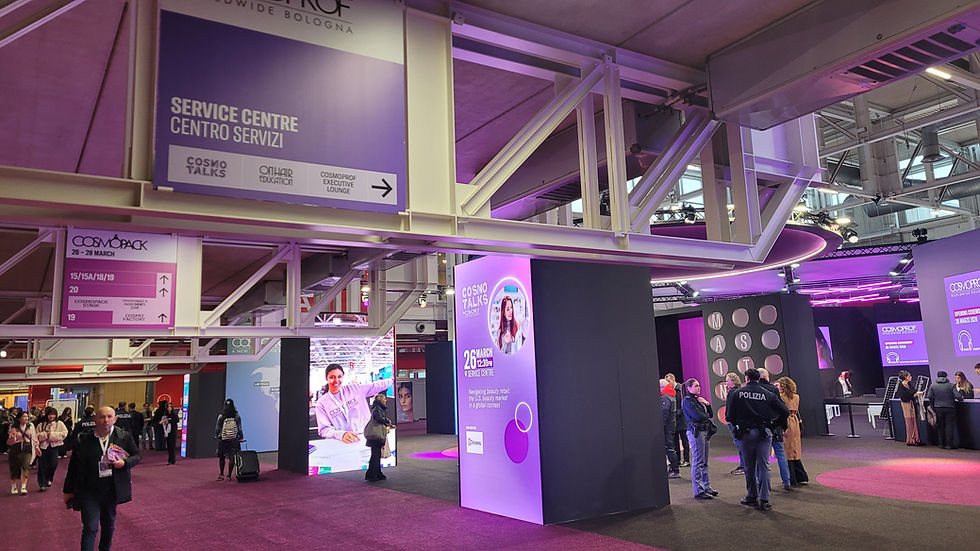
The Macro Shift: Quality Over Quantity
For the past decade, K-Beauty dominated through "speed-to-market" and an overwhelming volume of SKUs. However, the 2026 research identifies a critical pivot: Intentionality. Leading Korean firms are no longer just exporting products; they are exporting curated "Strategic Portfolios." This move from a trend-driven model to a positioning-driven model is the hallmark of a maturing industry.
1. The Specialization of Categories (The Rise of Hair-Longevity)
One of the most striking observations was the professionalization of the haircare sector. Brands like Dr.FORHAIR, KUNDAL, and Gravity have moved beyond generic cleansing to "Hair Longevity" and "Scalp-Science."
Insight: By applying advanced skincare active ingredients (PDRN, Exosomes) to scalp care, K-Beauty is creating a new premium category. This specialization allows brands to command higher price points and build stronger loyalty in the US and European markets, where "Skinification of Hair" is a top-tier trend.
2. From Retailers to 'Brand Builders'
The presence of CJ Olive Young at Cosmoprof Bologna was not merely as a retailer, but as a sophisticated brand incubator. Their PB (Private Brand) portfolio demonstrated how a data-driven understanding of consumer behavior can be translated into a global brand world.
Strategic Takeaway: The "Olive Young Standard" is now a benchmark for global buyers. It proves that a deep understanding of the "Value Chain"—from sourcing to merchandising—is a more sustainable competitive advantage than any single viral product.
3. Precision Positioning in Global Markets
The research confirms that "Made in Korea" is no longer the sole selling point. Instead, it is being used as a Foundational Trust Layer.
The Shift: Brands are now leading with their unique identity (e.g., "Minimalist Barrier Care" or "Vegan Luxury") while using their Korean origin as a secondary validation of quality. This "Identity-First" approach is essential for surviving in a crowded global marketplace where consumers seek authentic brand stories over generic origin labels.

The K-Protocol — Formulation Engineering as the Global Benchmark
The defining realization of the 2026 Bologna circuit was that K-Beauty’s dominance no longer rests on "speed-to-market" or viral packaging. Instead, it is anchored in Formulation Engineering. Global partners are no longer just buying products; they are adopting the "K-Protocol"—a rigorous, science-backed approach to skin health that European and North American heritage brands are now actively benchmarking.
1. The Mainstream Integration of Regenerative Science (PDRN)
A pivotal shift observed was the democratization of PDRN (Polydeoxyribonucleotide). Once a specialized ingredient confined to high-end Korean dermatology clinics for post-procedure healing, PDRN has officially moved into the global mainstream.
Analysis: In the 2026 market, PDRN is recognized as the "global language" of regenerative beauty. It is being positioned as the ultimate solution for Collagen Boosting and Cellular Repair.
The K-Edge: While global brands are just beginning to explore this ingredient, Korean manufacturers demonstrated a superior ability to stabilize PDRN in diverse delivery systems—from high-potency serums to daily-use mists—maintaining efficacy without compromising the sensory experience.
2. Engineering the "Hyper-Gap": Nano-Emulsion Technology
The pinnacle of formulation engineering was evidenced by the "1,000-Trillion Moisturizer". This product is not merely a cosmetic; it is a feat of molecular physics.
The Technical Breakthrough: Utilizing advanced Nano-emulsion technology, Korean formulators achieved the "impossible ratio": incorporating nearly 30% oil content while maintaining a zero-gravity, lightweight texture.
Strategic Impact: This "Hyper-Gap" technology solves the historical trade-off between deep nourishment and aesthetic elegance. It addresses the specific needs of the European and North American consumer—who often deals with dry, calcified water conditions—without the occlusive heaviness typically associated with high-oil creams.
3. The Convergence of Devices and Topicals
The "K-Protocol" is increasingly defined by the synergy between Bio-actives and Beauty Tech. I observed a significant trend where European legacy brands (e.g., Vagheggi) are now following the path pioneered by Korea: integrating micro-current and LED devices directly into product delivery systems.
Observation: The award-winning 75.25 Longevity Cream featuring a micro-current cap is a testament to this shift.
Synthesis: What was once a "K-Beauty novelty" is now the Standard Operating Procedure for high-end global skincare. Korea remains the leader in this space by treating the device not as an accessory, but as a critical "absorption accelerator" for the formulation.
4. Lifestyle-Driven Innovation: The "Fauxzempic" Trend
Perhaps the most "field-responsive" trend was the rise of "Fauxzempic" solutions. As GLP-1 weight-loss medications reshape global lifestyle habits, a new skincare vacuum has emerged.
The Solution: K-Beauty has pivoted with incredible agility to provide topical solutions for "facial sagging" and "body contouring"—concerns often associated with rapid weight loss.
Insight: By combining data-driven Personal Wellness with high-performance firming technologies, Korean brands are proving they can solve real-world physical concerns through science, moving far beyond "pretty marketing."

The Asia-Pacific Prism — Navigating the Multipolar Beauty Landscape
The 2026 Bologna circuit signaled the end of the "K-Beauty Monologue." In its place has emerged a complex, multipolar "Asia-Pacific Prism." While Korea remains the dominant force in formulation engineering, regional competitors—specifically from China and Thailand—are aggressively redefining the "Value of Experience."
1. The Aesthetic Counter-Offensive: Visual Experience as a Moat
One of the most disruptive scenes at the exhibition was the sheer density of crowds at the Flower Knows booth. Their dominance was not driven by a "miracle ingredient," but by Aesthetic Processing.
Analysis: While K-Beauty focuses on the "Invisibles" (Nano-emulsions, PDRN stabilization), Chinese brands are capturing the global consumer through the "Visibles." By utilizing precision molding and intricate multi-color injection technologies, they have transformed cosmetics into "Art Objects" reminiscent of European Baroque or Rococo aesthetics.
The Competitive Gap: This "Kawaii Aesthetic" combined with high-precision manufacturing targets the Psychological Ownership of the consumer. It reminds us that in the digital age, the "Visual Hook" is often the first point of entry before a consumer ever experiences the formulation.
2. Diversification of the Asian Identity
The presence of brands like Florasis, Judydoll, and Mistine (Thailand) across global platforms like YesStyle demonstrates that the "Asian Beauty" category is fragmenting into distinct strategic identities.
The Emerging Player (Thailand): Thailand’s Mistine showcased significant scale, proving that Southeast Asian brands are leveraging their expertise in "Humidity-Proof" and "High-Pigment" cosmetics to challenge K-Beauty in tropical and high-heat markets.
The Regional Shift: We are witnessing a transition from a K-Beauty-centric market to one where Category Specialization defines the winner. K-Beauty is the leader in Derm-Science, while C-Beauty is emerging as the leader in Curation & Aesthetic Packaging.
3. The Convergence Challenge: Formulation vs. Sophistication
The "Asia-Pacific Prism" forces a strategic re-evaluation for Korean brands. To maintain a competitive hyper-gap, innovation must now extend beyond the laboratory.
Strategic Synthesis: The research indicates that the next frontier of competition is the Sophistication of the Visual Experience. If K-Beauty can marry its "K-Protocol" (superior formulation) with the "Aesthetic Sophistication" currently being demonstrated by C-Beauty, it will create an insurmountable moat.
Observation: The current vacuum in the market is for products that feel as luxurious and "collectible" as they are scientifically effective.

Operational Excellence — Supply Chain Integrity as the Strategic Moat
Beyond the aesthetics and the science, the 2026 research identified a "Cold Reality" in the back-office of global retail. For Tier-1 distributors (e.g., Douglas), the conversation has shifted from "How does it work?" to "How do you deliver?"
1. Logistical Reliability as a Non-Negotiable
In the post-pandemic era of 2026, global retailers are hyper-sensitive to Supply Chain Vulnerability. * The Buyer’s Lens: During field interviews, it became clear that "Made in Korea" is only the first step. Buyers now demand detailed roadmaps for Supply Chain Integrity, including localized warehousing, real-time inventory tracking, and compliance with increasingly complex European EPR (Extended Producer Responsibility) regulations.
K-Beauty’s Advantage: Korean firms that have invested in Vertical Systems—controlling everything from raw material cultivation (e.g., Jeju Aloe farms) to automated packaging—are winning the trust of "Big Retail."
2. From 'Supplier' to 'Integrated Strategic Partner'
The successful Korean brands at Bologna were those positioned as Integrated Strategic Partners. They didn't just offer a product; they offered a Full-Stack Solution—R&D, regulatory compliance, logistical stability, and marketing narratives tailored to the local climate (e.g., addressing hard water and dry European air).
Strategic Conclusion of the Field Report
The 2026 Cosmoprof Bologna was a litmus test for the "K-Standard." It proved that Korea is no longer a peripheral player but the Game Changer of a $450 billion industry. By mastering the intersection of Bio-Tech, Aesthetic Sophistication, and Logistical Integrity, K-Beauty is not just surviving the Asia-Pacific competition—it is rewriting the rules of the game.


Comments