


K-beauty Marketing Starts with Product Planning, Not Product Launch

There is a romantic illusion that cosmetics planners fall into all too easily: the belief that "if the product is genuinely good, people will go crazy for it once they try it." However, reality is cold. Every year, thousands of "good products" expire in the dark corners of logistics warehouses without ever touching a consumer's face. This happens because the hard-earned strengths injected into a product by its planner evaporate without a trace the moment they enter a smartphone screen.
At the Beauty BM Intelligence Summit 2026, Eunsol Lee, CEO of 4 AM, bluntly exposed the core of these devastating failures. She pointed out that an arrogant, supplier-centric perspective is the primary culprit ruining marketing. A "miracle ingredient" spelled out in a text-heavy planning proposal fails to catch the eye of a consumer scrolling through short-form videos for even 0.1 seconds.
Lee’s message was sharp and precise. Marketing is not a cardiopulmonary resuscitation (CPR) tool to be used after a product is fully manufactured; it is a blueprint that must be embedded into the very skeleton of the product from the very first step of planning. In a fast-paced short-form world driven by busy thumbs, a product that fails to deliver an intuitive, visual impact within one second probably shouldn't have been born in the first place.

Influencers Can Never Prove a Vegan Mask Sheet in a 20-Second Video
Behind every marketing failure, there is always a planner who insists on using the "supplier's language." Brand teams gather in meeting rooms to define seemingly sophisticated Unique Selling Points (USPs) such as "relieves facial flushing," "contains deep sea water," or "certified vegan mask sheet." However, the short-form influencers and marketers who inherit these flashy specifications let out a deep sigh. This is because a Korean consumer's facial redness rarely shows up under bright camera lighting, and visually demonstrating clear, transparent deep sea water in a 20-second Before & After (B&A) video is virtually impossible.
Ultimately, attributes like a "vegan mask sheet"—which require long-winded verbal explanations—become completely powerless in a Shorts-driven world where users scroll away in one second. The more a planner tries to faithfully pack in their intended message, the more exponentially difficult the marketing becomes. Even if you push influencers by handing them strict product guidelines, the only things you will get back are tactical complaints, such as: "The finish of the video looks too greasy, which highlights skin flaws on screen," or "The effect isn't as visually apparent as I thought."
Even the credibility of a famous pharmaceutical company or a cruelty-free eco-certification fails to serve as a powerful weapon in the realm of short-form content. This is because the moment a consumer encounters a product is a fleeting, one-second window while mindlessly scrolling through Instagram Reels in bed before going to sleep. Consumers are not free enough to read the detailed ingredients written in the caption. The planner's noble intentions are brutally crushed by cold digital algorithms and consumer indifference.

Repeat Purchases are Driven by Product Quality, but the First Purchase belongs Entirely to 'Perceived Efficacy'
In retail marketing, the importance of repeat purchases is frequently emphasized. The logic dictates that once customers taste or use a product, they become loyal consumers who sustain the brand. However, CEO Eunsol Lee counterargued that, from a marketing perspective, driving the "first purchase" is paramount. No matter how long-lasting or beautifully textured a pharmaceutical cosmetic product is, if the consumer's wallet doesn't open for that initial purchase, the product will never even be granted the opportunity for that glorious repeat purchase.
This is where the roles of the planner and the marketer diverge sharply. Product performance, actual efficacy, and the smooth application texture are retention factors for the Brand Manager (BM) to worry about. On the other hand, the acquisition factor for the first purchase—which marketing controls—is rooted entirely in visual intuition: "interest," "novelty," and above all, looking good and looking like it works. When searching for collagen jellies on TikTok, it is a battle of whether your product possesses a visual trigger that makes consumers instantly pick it out from a sea of thumbnails and say, "Oh, it's that one!"
This rule holds true in global marketing across the world. Being ranked number one at Olive Young in Korea or executing large-scale spending fronted by famous celebrities does not resonate deeply with overseas consumers. If you place four photos of ordinary textures that consumers can easily imagine side by side, even a marketer would struggle to identify which company made which product if the logos were covered. Ultimately, if you do not simulate "how this product will look stamped onto a TikTok thumbnail or Google Images" right from the planning stage, marketers are left with zero cards to play.

Design Gritty Data Points Meticulously Instead of Fancy Reports
The secret to boosting marketing efficiency and maximizing ROI (Return on Investment) ultimately lies in data. However, the data Lee refers to does not consist of the polished, fancy numbers presented in the elegant executive boardrooms of conglomerates. The data points closest to the real answer are the actual batting averages of competitors' content, and the raw, unfiltered feedback uttered by influencers during the process of executing campaigns.
For efficient influencer seeding marketing, a brand must first conduct a clear self-diagnosis. You must check whether the TikTok app and a VPN are installed on your mobile phone right now, and whether at least five different brand thumbnails catch your eye when searching for your product's core keywords. If you shake your head at these questions, chances are high that the brand is completely detached from market trends, masturbating in its own world about having made a "good product."
A successful product workflow is a cyclical structure that tightly combines competitor analysis, influencer feedback, and internal performance data. A marketer's job should not end with sending a hand-written note and a polite greeting asking an influencer if they "received the product safely." You must track and monitor until the very end whether the visual intuition of the product designed during the planning stage survives intact within the influencer's roughly edited video. The only key to overcoming the numerous failures that end as one-hit wonders is connecting these gritty data points.
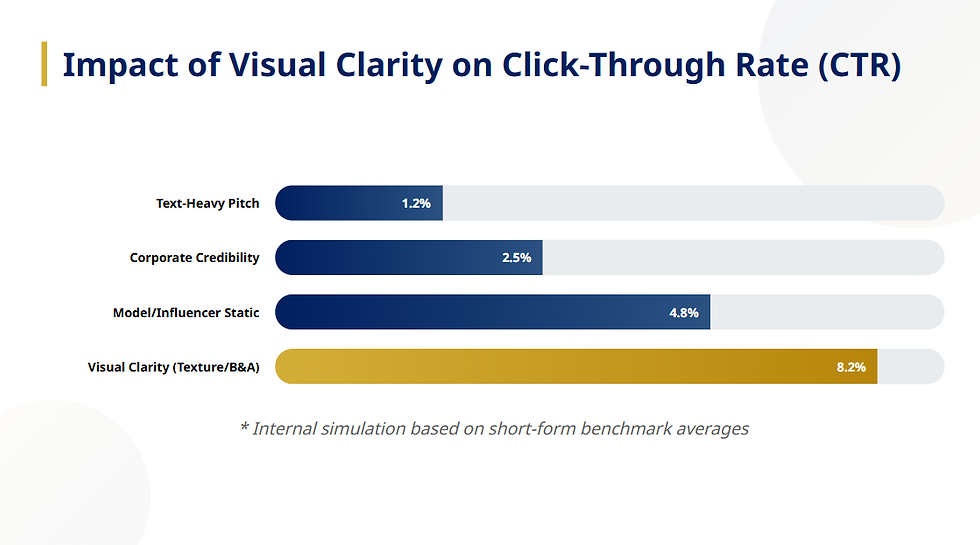
K-beauty marketing strategy for Surviving a 1-Second World
Henry Ford famously said, "If I had asked people what they wanted, they would have said faster horses." Cosmetics planners might similarly be obsessed with creating only "softer and safer horses," trapped inside consumer surveys and ingredient trends. However, today's consumers do not want a horse; they want an overwhelming visual shock that commands them to stop scrolling—much like Tesla's Cybertruck.
Making a good product is a fundamental business baseline and a prerequisite for repeat purchases. However, introducing that good product to the consumer for the first time belongs entirely to the realm of marketing—and this marketing is pre-determined on the planner's desk. A USP that does not consider how it will be visualized within the frame of a short-form video is nothing more than surplus text for the supplier's self-gratification.
Is the intuition to capture the eyes of global consumers busy thumb-scrolling in bed within one second baked into your product proposal? If you cannot answer this question clearly and visually, your product will remain forever a "good product that nobody knows because they’ve never tried it," no matter how brilliant a marketer you hire.


Comments