


Lipstick Built K-Beauty’s Empire. Shampoo Is Eating Its Lunch.
In August 2026, Korean shampoo left the country at $6.00 a kilogram, up from $5.00 a year earlier. Korean lip makeup left at $55.10 a kilogram, down from $62.30. Both categories shipped more volume than they had the year before. Only one of them was paid more for it. The export line K-beauty built its reputation on is now growing by charging less, and the line nobody wrote about is growing by charging more.
What do the customs figures actually say?
Hair products move under HS 3305, the tariff line covering shampoo, conditioner, styling and scalp preparations. A tariff line is the customs classification an exporter declares at the border, and it is the unit in which trade statistics are kept. Exports under it reached $403.25 million in the first eight months of 2026, up 33.7% on the same period a year earlier.
Shampoo alone, HS 330510, accounted for $155.12 million of that, or 38.5% of the line, up 38.3%. Full-year shampoo exports in 2025 were $178.07 million, so eight months of this year reached 87% of the whole of last year. Lip makeup moves under HS 330410. In August it shipped $41.97 million, up 4.8% from $40.05 million.
Which category is growing on price, and which on volume?
In August, shampoo exports rose 35.7% in value, from $15.75 million to $21.37 million. Volume rose 12.8%, from 3,149.1 tonnes to 3,551.5 tonnes. The average price rose from $5.00 to $6.00 a kilogram, up 20.3%. Most of the growth was price.
Lip makeup rose 4.8% in value over the same month. Volume rose 18.4%, from 642.9 tonnes to 761.4 tonnes. The average price fell from $62.30 to $55.10 a kilogram, down 11.5%. The category shipped 18% more product for 5% more money.

How does hair care’s record compare with its own history?
Hair product exports were $416.51 million in 2021, then fell to $341.86 million in 2022, a drop of 17.9%. They recovered to $358.22 million in 2023 and $413.08 million in 2024, and reached $478.17 million in 2025, up 15.7% and a record.
A record in 2025 therefore sits on a line that spent three years climbing out of a single bad year. What is different about the current run is the rate rather than the level. Exports reached $232.72 million in the first five months of 2026 against $178.15 million a year earlier, up 30.6%, and $403.25 million through August, up 33.7%. Neither of those is a recovery number.
On the comparison with lip makeup, one caution belongs in the open. The customs series publishes lip makeup by month rather than as a running total for the same window, so the point at which the two lines crossed cannot be dated from the public figures. Lip makeup shipped $53.8 million in April and $41.97 million in August, a monthly range that sits below hair care’s pace. A range is not a crossing date. What the published figures do support is the direction of each line and the price behaviour underneath it.

Why do two official figures for the same category disagree?
The customs line puts 2025 hair product exports at $478.17 million. The Ministry of Food and Drug Safety’s 2025 production and export statistics put hair products at $590 million, 5.1% of $11.4 billion in total cosmetics exports. The gap is $112 million on a category of that size.
Neither figure is wrong. One counts a tariff line; the other counts a product type as defined under cosmetics law, and the two sets do not hold the same items. Anyone sizing the category picks a number more than a hundred million dollars apart depending on which register they read.
The same register problem blocks the lip comparison entirely on the regulatory side. The ministry’s statistics group lip products inside colour cosmetics, which it puts at $1.51 billion, or 13.2% of exports, alongside eye and face products. Basic skincare is 74.7%, at $8.53 billion. Lip makeup exists as a separate number only in the customs series.
Where is the shampoo money coming from?
Through August, the United States took $35.11 million of Korean shampoo exports, up 84.2%, and has been the largest single market for six consecutive months. China took $23.05 million, down 1.3%. Greater China, meaning China, Taiwan and Hong Kong together, took $39.84 million, up 5.5%, with its share of shampoo exports falling from 35% across 2025 to 26% in the first eight months of this year.

The August detail shows where the price came from. US value rose 30.6% to $4.503 million on volume up 4.7%, with the average rising from $5.50 to $6.90 a kilogram, up 24.7%. China’s value fell 12.9% to $2.787 million while its average rose from $3.40 to $4.90 a kilogram, up 43.9%. Fewer shipments, higher prices, in both directions.
The highest average among the ten largest destinations in August was the Netherlands, at $25.80 a kilogram on $773,000 of shipments, more than four times the category average. Canada took $1.12 million at $6.20 a kilogram and Poland $1.117 million at $6.40. Brazil rose 179.0%, from $291,000 to $812,000.
What is happening to lip makeup’s best markets?
In August the United States remained the largest destination for lip makeup, but its value fell 8.1% and its average price fell from $51.70 to $47.10 a kilogram. Japan’s value and average both fell, the average from $73.10 to $64.20. China’s value fell from $2.467 million to $2.045 million while its average edged up from $69.70 to $71.80. Vietnam’s value fell with its average down from $80.80 to $63.70.
Growth came from cheaper ground. India’s value rose 77.3%, from $810,000 to $1.436 million, with the average falling from $67.50 to $44.70 a kilogram, a third off the price. The exception runs the other way: the United Kingdom went from $918,000 to $2.249 million with its average rising 13.4% to $111.90, the highest of the major markets. Türkiye took $1.717 million at $87.20.
The ranking had already moved earlier in the year. In April, lip makeup exports totalled $53.8 million, up 5.1%, with Japan at $17.0 million and up 62.4%, overtaking the United States at $13.9 million and down 7.8%.
Is the domestic market feeding the export line?
Hair care has been the fastest-growing category at CJ Olive Young, with annual growth above 70%. In the first two months of 2026 its hair product sales rose 48% and styling sales rose 90%. Nine in ten users of its scalp diagnostic service are international tourists. Those figures are the retailer’s own.
The tourist channel has changed scale underneath them. 18.5% of foreign visitors to Seoul used a hair salon or beauty service in 2025, against 3.6% in 2019, a rise of 14.9 percentage points, according to the Seoul Tourism Foundation’s survey.
Capital has followed the same line. In September 2025 Blackstone took a controlling stake of more than 70% in Juno Hair, a salon chain of more than 180 locations, for over 500 billion won — about $372 million at the rate of 1,345.1 won to the dollar at which the won closed on 13 October 2026, the rate used for every conversion in this article. Grand View Research projects the Korean hair care market to grow from $3.8 billion in 2024 to $6.1 billion by 2030, a compound annual rate of 8.4%.

Whose numbers are these, and what do they actually claim?
Cosmax reports hair care revenue up about 65% in the first half of 2026 and 37 patent applications in hair care over the past three years. Those are applications rather than grants, and the figures are the company’s own.
The work behind them is specific. The company has completed a patent application for a model that estimates alopecia areata risk without taking a biological sample, trained on about 22 million national health checkup records from Korea and Japan across 33 variables including blood pressure, liver enzymes, and demographic and socioeconomic indicators. It has analysed scalp target lipids in 387 subjects of East Asian, European and African descent and grouped scalps into three types, with a biomarker panel by ancestry planned. With Seoul National University it developed CORELINK-S, a material the company says improves the tensile strength of damaged hair by more than 120%. It received an IFSCC award in 2025 for organoid work — laboratory-grown tissue models used in place of human or animal testing — on stress-related greying.
Separately, Cosmax recorded triple-digit hair care export growth in each of the three years from 2023 to 2025, and Kolmar Korea expanded its hair care research headcount by 40% last year. A scalp claim that survives review in three jurisdictions is worth more per kilogram than one that does not, and that is the part of the price the customs file registers without explaining.

On the brand side the same discipline applies. Dr.Groot, from LG H&H, has been in 682 Costco stores in the United States since September last year and entered Sephora in March 2026. The company announced that it won Best Fine Hair Shampoo & Conditioner at the Allure 2026 Best of Beauty Awards, the brand’s first such win.
LG H&H’s own position moved with it. North American revenue in the first half of 2026 was 395.6 billion won, about $294 million, up 33.0%, ahead of China at 323.7 billion won. North America’s share of total revenue rose from 9.0% to 12.2%.
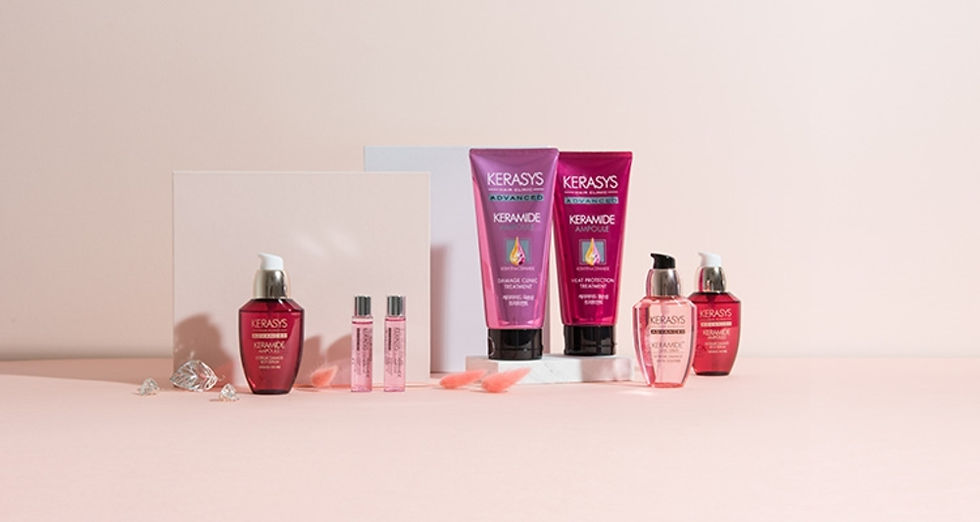
Kerasys, from Aekyung Industrial, was in about 390 Walmart stores in the United States as of March 2026. Amorepacific sells hair care in 17 countries, and its Mise en scène Perfect Serum ranked first in Amazon’s hair oil category during the Big Spring Sale. Ryo’s growth in China was described as steady when it was last reported in March 2026, with no figure attached. Gravity, from Polyphenol Factory, reports cumulative sales of 1.85 million bottles within two years of launch — again, the company’s own count.
Does a higher price per kilogram mean a better business?
Not on its own. Shampoo is mostly water in a heavy bottle; lip makeup is light and dense in value. $6.00 against $55.10 a kilogram says nothing about margin, and the two numbers should not be read against each other directly.
What survives the comparison is direction within each line, measured against its own prior year. Shampoo’s buyers accepted a 20.3% higher price and took 12.8% more volume anyway. Lip makeup’s buyers took 18.4% more volume and paid 11.5% less for it.
One further caution. HS 3305 is a tariff line, not a brand. It holds salon and mass products, private label and own-brand, premium and bulk, in the same number. A rising line average can mean a better mix or simply fewer low-price bulk shipments. The country detail — a 24.7% price rise in the United States, 43.9% in China on falling volume — points to mix. The customs data cannot settle it alone.
What this leaves for manufacturing, brands and buyers
For manufacturers, the argument for a higher price is a patent file and a laboratory result rather than a label. That is slower to build than a campaign and harder to copy once built.
For brands, the uncomfortable reading is that the line gaining price is the one with the least brand recognition abroad, and the line losing it is the one with the most. Recognition and pricing power are not the same asset.
For buyers and retailers, the arithmetic has changed on both shelves. Hair care costs more per unit than it did and still moves. Lip makeup costs less and needs more units to stand still.
The customs file does not say which of those holds. It says which one is happening.

Comments